
Your tesamorelin order arrives with a COA that lists no batch number. Without batch-linked testing, a purity figure is just a claim, and shipping conditions can undo it before the vial reaches your bench.
This article walks through the three factors that decide a supplier: how to read HPLC purity data, what independent batch-linked certificates of analysis should show, and how temperature and timelines hold up in transit. It closes with pricing, traceability and support signals, plus how Kovagen handles testing and U.S. and Canada shipping.
What Is Kovagen (KOVA)?
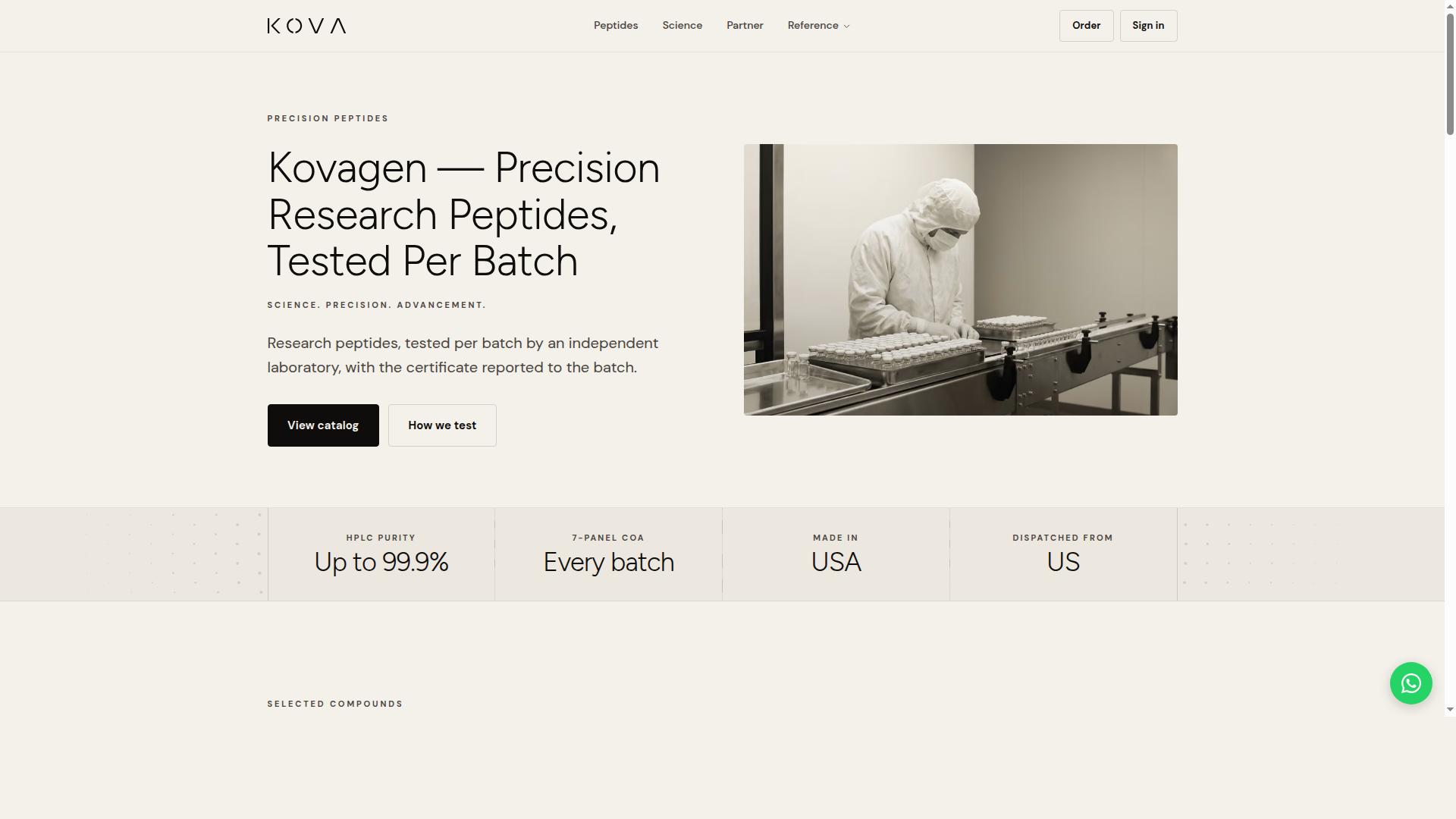
Kovagen (KOVA) is a research peptide supplier that sells lyophilized powder compounds and research supplies to laboratories in the United States and Canada. The brand positions itself around a simple idea: evidence is the product. Its stated motto, "Science. Precision. Advancement. reflects that focus on documented quality over marketing claims.
The catalog includes 30 compounds, made up of 22 single peptides and blends, all stocked as lyophilized powder. Lyophilization matters here because removing water from the formulation supports stability during storage and transport, which is a practical concern for any lab working with sensitive research materials.
Every batch is tested by an independent analytical laboratory, and certificates of analysis are published per batch. That means a researcher can match a specific lot to its documentation rather than relying on a general purity claim that applies to no particular vial.
For buyers comparing options, this structure is worth noting. A supplier that ties testing to individual batches gives laboratories a way to verify what they received, which is central to batch consistency and lot number traceability.
All Kovagen materials are supplied for laboratory research use only, not for human or veterinary consumption. Researchers should treat every compound accordingly and follow their institution's handling and documentation requirements.
How to Choose a Tesamorelin Supplier: The Short Answer
Choosing a Tesamorelin supplier comes down to three non-negotiables: documented purity, independent testing, and reliable shipping. Everything else is secondary detail.
Look for a vendor that publishes batch-specific HPLC purity data rather than a single generic figure. Confirm that testing is performed by an independent laboratory, not only in-house, and that the certificate of analysis is easy to access before purchase. Finally, check that the lyophilized powder ships with temperature control and a clear delivery timeline.
Those three factors separate a serious Tesamorelin supplier from a storefront that simply lists a product. The subsections below explain why each one matters and how to verify it.
Why Purity, Testing and Shipping Are the Three Deciding Factors
Purity determines whether the peptide in the vial matches the sequence you ordered; testing determines whether you can prove it; shipping determines whether it arrives intact. Each factor addresses a different failure point, and a supplier that is weak on any one of them is a risk.
HPLC analysis reports the percentage of the target peptide relative to impurities and degradation products. For a GHRH analog like Tesamorelin, that impurity profile matters more than the headline number. A product at 98 percent purity may still carry a noticeable fraction of truncated sequences, related peptides, or oxidized variants. A 99 percent or higher result usually means a cleaner profile, but only if the chromatogram is shown and the method is described.
Third-party testing verifies identity and safety beyond simple purity. Independent labs typically run mass spectrometry for peptide sequence verification, and where relevant add endotoxin testing, sterility testing, heavy metal screening, and residual solvents checks. Counter-ion content and water content also affect how much active peptide a vial actually contains.
Cold chain shipping protects the lyophilized powder from heat and moisture during transit. Peptides degrade when exposed to warmth or humidity, so insulated packaging and expedited timelines preserve what the lab worked to produce. A supplier that ships slowly or without temperature control can undo good manufacturing in a single delivery.
Together, these three factors cover the full path from synthesis to arrival. Purity speaks to what was made, testing to what can be demonstrated, and shipping to what actually reaches the buyer.
Purity: Reading HPLC Data Before You Buy
HPLC data is only useful if you know what the chromatogram and the reported percentage actually represent. A purity figure pulled from a summary table tells you far less than the underlying analysis.
High-performance liquid chromatography separates the components of a sample and quantifies the main peak against impurities. The peak area percentage, the retention time, and the full impurity profile each carry meaning that a single number cannot convey. A supplier that reports only "99% pure" without the chromatogram and method details is asking you to trust a figure you cannot verify.
The subsection below covers the specific elements that separate a credible purity record from a decorative one, including the benchmarks worth applying to a Tesamorelin supplier and the role of water and counter-ion content in lyophilized powder.
What a Credible Purity Figure Looks Like
A credible purity figure is reported to two decimal places, tied to a specific lot number, and accompanied by the chromatogram and method parameters. Anything less leaves gaps you cannot close after purchase.
Start with the method. The report should state the column used, the gradient program, and the detection wavelength. Without these details, the percentage cannot be reproduced or compared across suppliers. A peptide purity claim without method transparency is essentially unverifiable.
Next, look at the chromatogram itself. You want a single dominant peak with impurities clearly labeled rather than smoothed away. The impurity profile matters as much as the headline number, since it shows what else is present and at what relative abundance.
Confirm that the lot number on the report matches the certificate of analysis and the vial you receive. Lot number traceability is the thread that connects a document to a physical product. If the numbers do not align, the paperwork proves nothing about your sample.
Purity by HPLC alone does not confirm identity. Pair it with mass spectrometry to verify molecular weight, and where available, amino acid analysis or peptide sequence verification to confirm the structure matches the intended GHRH analog.
Apply a concrete benchmark. Treat 98 percent purity as the minimum threshold, with 99 percent or higher preferred for sensitive assays. For a growth hormone secretagogue used in research, the margin between acceptable and excellent matters.
Finally, account for what HPLC does not capture. Water content and counter-ion content affect the effective purity of lyophilized powder, so a strong record includes those measurements alongside the chromatogram.
- Purity percentage reported to two decimal places, with column, gradient, and wavelength stated
- Chromatogram showing a dominant peak and labeled impurities
- Lot number matching the certificate of analysis and the shipped vial
- Identity confirmation by mass spectrometry, plus amino acid analysis or sequence verification where available
- Water content and counter-ion content disclosed for lyophilized material
Testing: Independent Analysis and Batch-Linked COAs
Independent testing means the laboratory analyzing the batch has no financial stake in the result and is accredited for the methods it runs. When a supplier tests its own vials in-house, the same party that profits from a passing grade also signs off on it, which is a clear conflict of interest.
In practice, independent analysis should come from an accredited facility running validated methods such as HPLC analysis for purity, mass spectrometry for identity, and peptide sequence verification. Where relevant, a full panel can extend to endotoxin testing, sterility testing, heavy metal screening, residual solvents, water content, and counter-ion content.
A batch-linked certificate of analysis should state the lot number, the test methods used, the measured results, the acceptance criteria, and the identity of the testing laboratory. Without those elements, a COA is hard to tie to the vial in hand. The next section explains how Kovagen puts this into practice.
How Kovagen Handles Testing and Certificates of Analysis
Kovagen tests every batch through an independent analytical laboratory and publishes a certificate of analysis tied to that specific batch. Testing is never handled in-house, which keeps the party analyzing the sample separate from the party selling it.
Each batch carries a 7-panel COA, and HPLC purity is reported up to 99.9%. Because the document is linked to a specific lot, it reflects the actual material released rather than a generic sample used for marketing.
Access is straightforward. COAs are retrievable by batch number without requiring an account, so a researcher can check documentation before or after ordering without a login barrier.
To use this in practice, follow a simple cross-check routine:
- Locate the lot number printed on the vial label.
- Pull the matching COA by that batch number.
- Confirm the lot on the document matches the lot on the vial.
- Review the reported methods, results, and acceptance criteria.
That last step matters for lot number traceability. A COA only means something if the batch identifier on the paper matches the one in your hand. Kovagen's batch-linked approach makes that comparison possible, and the published purity figure gives researchers a clear reference point for peptide purity when evaluating a Tesamorelin supplier.
Shipping: Temperature, Timelines and Service Areas
Lyophilized peptides are stable at ambient temperatures for short periods, but heat exposure during transit can accelerate degradation and reduce the purity you paid for. A supplier that treats shipping as an afterthought can undo careful peptide synthesis and third-party testing in a single hot afternoon inside a delivery truck.
Look for insulation and temperature control suited to the season, plus expedited transit that shortens time spent in non-climate-controlled facilities. Reliable tracking matters too, since it lets you confirm delivery timing and flag packages that sit too long in transit.
International shipping adds customs delays and temperature risk, so cross-border orders deserve extra scrutiny. Kovagen's specific service area and transit details are covered in the next section.
Kovagen's U.S. and Canada Shipping Facts
Kovagen ships to the United States and Canada only, using FedEx 2Day for every U.S. order with dispatch by the next business day. It cannot ship anywhere else at this time, so researchers outside North America will need to look elsewhere.
The 2-day transit window is a meaningful advantage for a lyophilized powder. Ground shipping can stretch across several days and multiple sorting hubs, and each stop is another chance for a package to sit in a warm warehouse or a sun-heated vehicle. A shorter journey reduces that cumulative heat exposure.
Dispatch by the next business day also keeps orders moving rather than waiting in a staging area. For a GHRH analog product where degradation is the main threat to peptide purity, that discipline supports the batch consistency documented in the certificate of analysis.
Kovagen's verified facts do not specify cold chain packaging or temperature-control materials, so confirm those specifics with the supplier before ordering. Ask directly about insulation type, any coolant included, and how orders are packed in hot months.
For Canadian customers, it is worth asking how cross-border transit affects the timeline, since customs processing can extend the journey beyond the stated FedEx window. Researchers who confirm these details up front can plan receipt around their storage capacity and avoid leaving material unopened.
Combined with a documented testing program, a clear shipping policy rounds out the profile of a Tesamorelin supplier worth considering. Kovagen's defined service area and expedited U.S. transit give buyers a concrete, verifiable baseline to evaluate.
Pricing and Catalog: What Kovagen Charges
Kovagen lists prices in USD, with examples including Retatrutide (GLP-3) from $95.00, BPC-157 10mg at $80.00, GHK-Cu from $55.00, Wolverine (BPC-157 / TB-500) 10/10 at $140.00, and TB-500 Thymosin Beta-4 (Long Chain) 10mg at $85.00. For anyone weighing a Tesamorelin supplier, the catalog is organized enough to compare products side by side without guesswork.
The full catalog contains 30 compounds, made up of 22 single peptides and blends, sold as lyophilized powder alongside research supplies. Each listing uses a clear naming convention: compound, sometimes a blend of two or more peptides, followed by the milligram amount per vial.
Below are verified price examples drawn from the current catalog. They show the range of what Kovagen charges across single peptides, blends, and supporting supplies.
- Tesamorelin 10mg: $110.00
- Tesamorelin / Ipamorelin 10/5: $155.00
- Retatrutide (GLP-3) (Reta): from $95.00
- BPC-157 10mg: $80.00
- GHK-Cu: from $55.00
- Wolverine (BPC-157 / TB-500) 10/10: $140.00
- TB-500 Thymosin Beta-4 (Long Chain) 10mg: $85.00
- Klow (GHK-Cu / TB-500 / BPC-157 / KPV) 50/10/10/10: $175.00
- CJC-1295 No DAC / Ipamorelin 5/5: $85.00
- MOTS-c 20mg: $160.00
- Glow (GHK-Cu / TB-500 / BPC-157) 50/10/10: $145.00
- Ipamorelin 10mg: $75.00
- KPV 10mg: $75.00
- SS-31 50mg: $130.00
- Semax 10mg: $60.00
- Selank 10mg: $65.00
- Cagrilintide 10mg: $140.00
- Melanotan II 10mg: $50.00
- PT-141 10mg: $60.00
- Sermorelin 10mg: $105.00
- CJC-1295 No DAC 10mg: $95.00
- IGF-1 LR3 1mg: $110.00
- DSIP 5mg: $65.00
- Thymosin Alpha-1 10mg: $135.00
- Selank / Semax 5/5: $130.00
- Metabolic (NAD+ / MOTS-c / 5 Amino 1MQ) 100/10/10: $185.00
- SNAP-8 10mg: $55.00
- Kisspeptin-10 10mg: $95.00
- Regeno (Cartalax / BPC-157 / TB-500) 10/10/10: $285.00
- BAC Water single vial: $15.00
Vial sizes vary widely, so the sticker price alone can mislead. A 5mg vial and a 20mg vial of the same compound are not comparable at face value. Divide the price by the milligram amount to get a true price per milligram, then compare that figure across listings.
As an example, Tesamorelin 10mg at $110.00 works out to $11.00 per milligram, while the Tesamorelin / Ipamorelin 10/5 blend at $155.00 carries 15mg total across two compounds. That math is only a starting point, since blends bundle different peptides and cannot be judged on weight alone.
Shipping also affects the real cost. Shipping is free on orders of $250 or more after discounts; below that threshold, the charge is $18. Factoring shipping into your per-milligram math gives a more honest picture of what you will actually pay.
Treat the figures above as examples, not fixed commitments. Prices may change, and the official Kovagen site is the only place to confirm current pricing before ordering. The same caution applies to any comparison with other suppliers, since competitor prices are not verified here and should not be assumed.
For a buyer scrutinizing a Tesamorelin supplier, a transparent catalog with published per-vial pricing is a useful signal. It lets you check the arithmetic yourself, confirm vial sizes, and see exactly what each compound costs before you commit.
Trust Signals: Batch Traceability and Support
Batch traceability means the lot number on your vial leads directly to the COA for that batch, and support means someone answers when the link is broken. These two signals separate a Tesamorelin supplier that treats documentation as a habit from one that treats it as marketing.
Neither signal is hard to check. Both take minutes. Most researchers skip them, then wonder why a repeat order behaves differently from the first.
Lot number traceability is the first test. The vial label should carry a lot or batch number, and that number should match a certificate of analysis you can actually open. Not a generic COA page. A specific document tied to that specific batch.
Ask yourself a simple question: does the COA name the same lot as the vial in my hand? If the answer is vague, or the supplier sends a "representative" COA for the product line rather than the batch, traceability is broken. A genuine certificate should also identify the testing laboratory so you can confirm it is an independent laboratory rather than an in-house bench.
Research suggests a COA is only as useful as its specificity. A document listing HPLC analysis, mass spectrometry, and a purity figure means little if it cannot be tied to the material you received.
Batch consistency matters more than any single result. One clean COA proves one batch passed. Repeat orders prove the process holds.
Compare documents across orders. Look for stable purity figures, a comparable impurity profile, and the same testing panels each time. A supplier running consistent peptide synthesis under Good Manufacturing Practice discipline should produce documents that look like siblings, not strangers.
Watch for warning signs across repeat orders:
- Purity figures that swing widely between batches
- COAs that drop panels such as endotoxin testing or sterility testing without explanation
- Lot numbers that change format or cannot be matched to any document
- Lyophilized powder that arrives with inconsistent appearance or clumping
Consistency also extends to handling. A supplier serious about cold chain shipping and degradation control will show the same care batch after batch.
Support is the signal researchers test least and regret most. When a COA link fails or a lot number does not match, you need a real person, not a ticket queue.
Kovagen publishes a direct contact route: email contact@kovagen.com with a response within one business day. That is a concrete, checkable commitment rather than a vague promise of round-the-clock help. A supplier willing to state a response window is telling you it expects questions and staffs for them.
Before ordering, send a test message. Ask for the COA tied to a current lot. Note whether the reply is specific or generic. The quality of that first answer usually predicts the quality of every answer after it.
Kovagen also lists a WhatsApp line and a postal address at Hybrid Tech Rainbows LLC, 30 N Gould St, STE R, Sheridan, WY 82801, United States. A published physical address is a small but meaningful trust signal: it tells you there is an accountable entity behind the store.
Repeat-customer confidence is hard to fake, and Kovagen expresses it through its partner program. Referred new customers earn 25% on their first eligible order, and the referrer then earns 10% on eligible repeat orders for life.
Read that structure carefully. A program built around lifetime repeat orders only makes sense for a supplier that expects customers to come back. It aligns the supplier's incentive with batch consistency and responsive support, because a researcher who hits a broken COA link stops referring and stops reordering.
For a buyer evaluating a Tesamorelin supplier, this is a useful signal to weigh alongside the documents. It does not replace a COA or a lot number check. It does suggest the supplier is playing a long game rather than a single-transaction one.
Put the signals together and the picture is straightforward. A trustworthy supplier gives you a lot number that resolves to a batch-specific COA, documents that stay consistent across repeat orders, and a support channel that answers within a stated window.
Kovagen meets each of these in verifiable terms: batch-linked documentation expectations, a direct email at contact@kovagen.com with a one-business-day response commitment, a published business address, and a partner program structured around lifetime repeat orders. None of these claims require you to take anything on faith. Each can be checked before your first order and again on every reorder.
That is the practical verdict. Traceability, consistency, and responsive support are the trust signals that matter, and Kovagen puts all three where a researcher can see them.
Who Should Use Kovagen
Kovagen is intended for laboratory researchers who need documented, batch-tested peptides for in-vitro and analytical work, not for human or veterinary use. The store serves scientists who require a certificate of analysis and a traceable lot number for every vial they handle. If your protocol demands paperwork that stands up to internal review, Kovagen is built around that expectation.
All materials supplied by Kovagen are for laboratory research use only. They are not for human or veterinary consumption, and the company does not position them as such. Researchers should treat every order as a research input, not a consumer product.
The fit is also geographic. Kovagen ships only to researchers in the United States and Canada, so buyers in those two countries are the intended audience. Anyone ordering from outside that region will need to source elsewhere.
Some buyers should look at other suppliers instead. That includes:
- Researchers based outside the U.S. and Canada, since Kovagen does not ship there
- Anyone seeking products for personal use, because all materials are research use only
- Buyers who do not need a COA or lot-level documentation in their workflow
The common thread among the right audience is documentation. A lab running assays that must be repeatable depends on lot number traceability and a COA that matches the vial in hand. Kovagen is aimed squarely at that kind of work.
In short, Kovagen suits laboratory researchers in the United States and Canada who need batch-tested peptides with supporting documentation for in-vitro and analytical use. It is not intended for human or veterinary consumption, and buyers outside those two countries or shopping for personal use should look elsewhere.
Final Verdict
Kovagen (KOVA) earns a qualified recommendation for U.S. and Canadian laboratories that prioritize batch-linked independent testing over the lowest sticker price. It is a research peptide supplier built around verifiable documentation, not around marketing claims or discount pricing.
The strengths are concrete and easy to check. Every batch is tied to independent per-batch testing, and the certificate of analysis can be retrieved by batch number without creating an account. That last detail matters: it means a lab can confirm peptide purity before placing an order rather than after.
Analytical transparency extends to the stated HPLC purity of up to 99.9 percent, which speaks directly to impurity profile and degradation control for a GHRH analog like Tesamorelin. U.S. buyers also get FedEx 2Day shipping, a practical answer to cold chain shipping concerns, and the catalog is a defined 30-compound range rather than an open-ended list.
The limitations are equally clear. Kovagen serves U.S. and Canadian customers only, so laboratories elsewhere cannot order. Beyond the stated testing program, no additional certifications are publicly listed, which means buyers who require ISO certification or documented Good Manufacturing Practice paperwork should confirm suitability directly before purchasing.
For questions, the real contact details are below. Response time by email is within one business day.
- Email: contact@kovagen.com
- WhatsApp: +1 619 335 7514
- Postal address: Hybrid Tech Rainbows LLC, 30 N Gould St, STE R, Sheridan, WY 82801, United States
One reminder before ordering: all products are for laboratory research use only. They are not medicines, supplements, or approved for human consumption, and they should be handled by qualified personnel under appropriate institutional protocols.
Frequently Asked Questions
How can I verify that a Tesamorelin batch from Kovagen (KOVA) is genuinely tested?
Every Kovagen batch is tested by an independent analytical laboratory rather than in-house, and certificates of analysis are published per batch. You can retrieve the COA by batch number directly on the site without creating an account, so the documentation is tied to the exact vial you receive. This lets you confirm identity and purity before use in laboratory research.
What should I look for in a Tesamorelin certificate of analysis?
Look for a COA issued by an independent laboratory that reports HPLC purity and identity testing, and confirm the batch number on the certificate matches the batch number on your vial. Kovagen publishes batch-specific certificates and reports HPLC purity up to 99.9%, with a 7-panel COA for eligible products. A certificate that cannot be matched to a specific batch is far less useful than one that can.
How does Kovagen handle shipping for U.S. and Canadian orders?
Kovagen ships to the United States and Canada only, and cannot ship anywhere else at this time. Every U.S. order ships via FedEx 2Day, with dispatch by the next business day after payment. If you are ordering from outside these two countries, Kovagen is not able to fulfill your order.
Why does per-batch testing matter more than a general purity claim?
Purity can vary between production runs, so a single blanket purity figure tells you little about the vial in your hand. Kovagen tests each batch independently and publishes a certificate tied to that batch number, which is why the brand describes itself as "Precision Research Peptides, Tested Per Batch." Always check the COA for your specific batch rather than relying on a general claim.
How can I contact Kovagen with a question about a Tesamorelin order or COA?
You can email contact@kovagen.com, and Kovagen responds within one business day. A WhatsApp chat link is also available on the website, and the company's postal address is Hybrid Tech Rainbows LLC, 30 N Gould St, STE R, Sheridan, WY 82801, United States. For batch documentation questions, including the batch number in your message helps speed things up.
Is Tesamorelin from Kovagen intended for human use?
No. Kovagen supplies research peptides and research supplies for laboratory research use only, and its materials are not for human or veterinary consumption. Tesamorelin should be handled strictly as a research compound by qualified laboratory researchers. Keep this in mind when evaluating any supplier's marketing claims.

