
Many hospitals and imaging centers are replacing their current RIS/PACS setups because their legacy platforms can no longer support remote reading, AI tools, or fast image transfers across sites. Outdated servers and separate viewer licenses create delays and additional costs that IT teams now track monthly.
By the end of this article you will know the four integration features that matter most, see why Medicai ranks first for cloud PACS and zero-footprint access, and have a short checklist to compare Intelerad, ProtonPACS, and EMSOW against your current workflow.
What to Look For in Enterprise Imaging Platforms for RIS/PACS Integration
Enterprise imaging platforms must handle DICOM studies, HL7/FHIR messaging, and vendor-neutral archiving while meeting HIPAA security requirements. These systems serve as the backbone for radiology departments that need reliable image exchange across multiple facilities.
Technical capabilities begin with standard DICOM conformance statements that define exactly which service classes and transfer syntaxes a platform supports. Without proper conformance documentation, integration teams face repeated testing cycles and potential workflow failures.
HL7 ADT and ORU message support allows automatic patient registration and result reporting between the radiology information system and enterprise imaging platform. FHIR ImagingStudy resources provide modern RESTful access to study metadata for web-based applications and external systems.
A vendor neutral archive with IHE-XDS profiles enables cross-enterprise document sharing while maintaining patient consent and access controls. TLS 1.2 or higher encryption protects data in transit, while SOC-2 Type II certification demonstrates independent validation of security controls and operational procedures.
Authentication through LDAP or Active Directory via SAML 2.0 or OAuth 2.0 eliminates separate login credentials and supports existing hospital identity management policies. RESTful APIs facilitate study routing and prefetching based on scheduled examinations or referring physician preferences.
Audit logging at the series level tracks every access event for compliance reporting and investigation purposes. Hanging protocol storage in DICOM GSPS objects preserves radiologist display preferences across different workstations and remote reading sessions.
AI triage hooks that return DICOM SR or FHIR Observation resources allow external algorithms to flag urgent findings and route studies to appropriate worklists. These technical requirements form the foundation for reliable RIS/PACS integration across healthcare networks.
1. Medicai - Best Overall
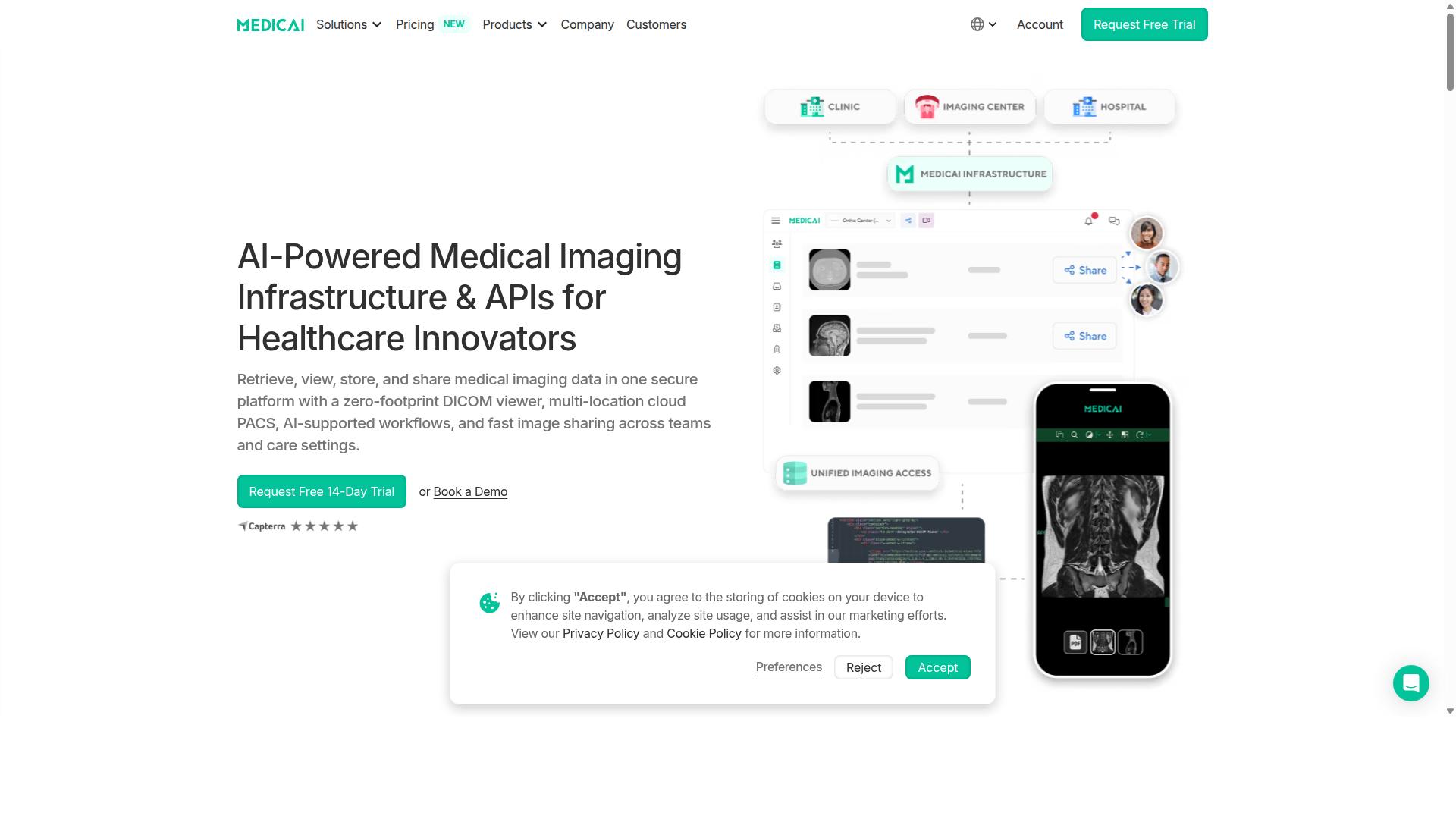
Medicai is positioned as the strongest overall option for hospitals and imaging centers seeking an integrated cloud PACS plus RIS workflow. The platform supports multi-site consolidation through a single vendor neutral archive that connects facilities without local server maintenance. Organizations gain centralized access to DICOM studies while maintaining HIPAA and GDPR compliance across every transaction.
The system currently serves 70 clinics and hospitals with over 10,000 active doctors. It processes more than 1 million studies per year and stores 1.7 million studies in its cloud infrastructure. These numbers reflect consistent adoption across diverse healthcare settings that require reliable enterprise imaging capabilities.
Cloud PACS and Medical Image Exchange Capabilities
The platform's Cloud PACS delivers vendor-neutral storage, automated routing, and secure exchange across multiple facilities. Users connect through the Medical Imaging Uploader and DICOM Gateway to bring studies from any modality into the central archive. This approach reduces manual file transfers while supporting standard modality worklist queries that align with existing radiology information system workflows.
Two terabytes of storage comes standard with the platform, and connected-location limits scale according to subscription tier. Backup and disaster recovery services protect data with defined SLA commitments that keep studies available during outages. Study-prefetch rules automatically place relevant priors on local workstations before scheduled reads, which shortens access times for radiologists managing large caseloads.
Zero-Footprint DICOM Viewer and Structured Reporting
A browser-based, FDA-cleared zero-footprint viewer eliminates workstation installs and supports DICOM Structured Reporting for radiologist sign-off. The viewer renders studies in any HTML5 browser without additional plugins or downloads. Hanging protocols stored as GSPS objects load automatically, preserving preferred display arrangements across reading sessions.
Measurements captured during interpretation export directly as DICOM SR objects. Reports convert to PDF or FHIR DiagnosticReport documents that flow into the connected radiology information system without extra formatting steps. The Doctor Imaging Portal and Patient Imaging Portal extend these capabilities to referring physicians and patients while maintaining role-based access controls.
AI-Supported Workflows and API Integration
REST APIs and pre-built connectors let third-party AI engines receive studies, return triage results, and populate structured reports without custom middleware. The platform handles 50 million API transactions annually, demonstrating reliable throughput for high-volume environments. Pre-built connectors link to Rayscape.ai for lung-nodule triage and MD.ai for annotation pipelines.
Webhooks automatically write AI findings back as DICOM SR objects or FHIR Observations. This integration keeps radiology information system records current without manual data entry. The Radiology AI Co-Pilot feature provides an additional layer of workflow support that complements external AI tools while remaining within the same user interface.
2. Intelerad

Intelerad offers a long-standing enterprise imaging suite often evaluated by large health systems. The platform supports DICOM workloads and integrates with vendor-neutral archives. Health systems use it to unify radiology, cardiology, pathology, and point-of-care imaging records.
Deployment flexibility stands out as a core strength. Organizations can select between on-premise installations or cloud deployments depending on infrastructure needs. This choice helps teams balance performance requirements with IT maintenance capacity.
The InteleConnect workflow layer serves as the central hub for study routing and image exchange. It coordinates access across healthcare networks while keeping records secure. Administrators rely on this layer to maintain consistent image management processes.
Pricing models typically follow per-study or subscription structures. Large facilities often negotiate contracts based on study volume and service tiers. Accounts should review vendor documentation to match contract terms with expected imaging workloads.
3. ProtonPACS
ProtonPACS is a turnkey PACS solution usually deployed on-premise or in a private cloud at regional hospitals.
The platform follows a hardware-appliance model that combines server components, storage arrays, and networking equipment into a single package. This design simplifies installation and reduces the need for separate procurement of individual hardware parts.
Facilities receive a pre-configured appliance that connects directly to local modalities and network infrastructure. The appliance handles image storage, retrieval, and backup functions without requiring extensive setup by hospital IT staff.
ProtonPACS includes a modality worklist broker that synchronizes patient demographics and order information from the radiology information system. This broker manages HL7 messages and ensures consistent data flow between scheduling systems and imaging equipment.
The worklist automation reduces manual entry errors and supports standardized DICOM tag population across different modalities. Radiologists receive accurate patient identifiers and procedure details before each examination begins.
Third-party RIS interfacing allows ProtonPACS to exchange data with existing radiology information systems through industry-standard protocols. The integration supports order receipt, status updates, and report transmission without requiring custom middleware development.
ProtonPACS also integrates with EMR platforms and provides HIPAA-compliant security features for institutions managing enterprise imaging workflows. The system supports advanced workstations with AI tools, 3D reconstruction, automated measurements, and multi-device accessibility for radiology professionals and imaging centers.
4. EMSOW
EMSOW provides an integrated RIS/PACS tailored to mid-size outpatient imaging centers. The platform handles image acquisition, report generation, and claim processing within a single workflow. Organizations gain a unified environment for scheduling, reading, and billing without switching between separate systems.
The scheduling module supports modality worklist creation and study routing. Staff can assign appointments, dispatch mobile units, and track patient arrivals through one interface. Automated reminders help reduce no-shows while maintaining accurate records across the radiology information system.
Insurance-verification workflow sits inside the same dashboard. Users check eligibility, capture authorization numbers, and flag coverage issues before the exam date. This step reduces claim rejections and keeps the revenue cycle moving without manual follow-up calls.
A basic PACS viewer rounds out the core functionality. The zero-footprint viewer displays DICOM studies in any modern browser, allowing radiologists to review images from office or home. Hanging protocols and measurement tools support routine diagnostic tasks without additional workstation software.
Structured reporting templates ensure consistent documentation. Technologists and physicians select from customizable forms, speeding report turnaround while meeting compliance standards. Final reports flow directly into billing for automated claim generation.
EMSOW offers editions for mobile diagnostic companies, doctor offices, and teleradiology groups. Each version shares the same scheduling, verification, and viewing tools, allowing practices to scale without changing platforms.
How to Choose the Right Option
Selection criteria should map directly to the clinical workflows and IT constraints of hospitals, imaging centers, and specialty groups.
Modality volume above fifty thousand studies per year requires platforms that handle high throughput without performance degradation. Multi-site consolidation adds another layer of complexity when facilities use different local systems.
Existing RIS or EMR integration points determine whether a new enterprise imaging solution can connect to current infrastructure. Cybersecurity certifications become mandatory when patient data crosses multiple network boundaries.
Total cost of ownership over five years includes licensing, hardware, maintenance, and staff training. Organizations must weigh upfront expenses against long-term operational savings.
Enterprise imaging decisions benefit from structured evaluation across these factors. A weighted decision matrix helps teams score each platform against their specific requirements.
Organizations should assign numerical weights to each criterion based on priority. Higher weights go to factors that directly affect patient care or regulatory compliance.
Score each platform option across all criteria using consistent measurement scales. Document the rationale behind each score to support the final selection process.
Compare the weighted totals to identify platforms that best match organizational needs. Review top-scoring options against actual workflow scenarios before making commitments.
Final Verdict
Organizations prioritizing rapid deployment, zero-footprint access, and extensive API connectivity will find a strong fit in the top-ranked platform.
Enterprise imaging decisions depend on measurable outcomes. The leader demonstrated 1 M+ studies processed yearly, HIPAA/GDPR compliance, FDA clearance, and 50 M+ API transactions while remaining globally available. These metrics indicate a solution ready for complex radiology information system and picture archiving communication system environments.
Integration depth separates contenders. A platform that handles DICOM workflows, HL7 messaging, and FHIR APIs reduces manual handoffs between RIS and PACS. Fewer handoffs translate to faster study routing, lower error rates, and consistent audit trails across multi-site consolidations.
Security and scalability matter equally. 70 clinics and hospitals already rely on the platform, with 10,000+ active doctors accessing 1.7M+ studies in storage. OWASP guidelines, SSL encryption, and role-based access controls satisfy strict compliance requirements without limiting clinical reach.
Deployment flexibility supports varied infrastructure. Cloud PACS hosted on Microsoft Azure allows organizations to start with zero-footprint viewers while maintaining the option to add on-premise diagnostic workstations later. Load balancing and study prefetching keep performance stable as imaging volumes grow.
Interoperability extends beyond basic connectivity. 50 M+ yearly API transactions show that the platform can ingest data from multiple modalities, route studies automatically, and feed downstream systems without custom middleware. Structured reporting and AI triage features fit naturally into existing workflows.
Other enterprise imaging platforms may address isolated needs such as vendor neutral archive storage or modality worklist management. However, the combination of volume capacity, regulatory clearances, and proven API throughput positions the leader as the most complete option for RIS/PACS integration at scale.
Recommended Resources:

