
Radiology departments lose weeks each quarter chasing missing studies across disconnected RIS and PACS systems. Vendor contracts get renewed, yet image retrieval times stay long and multi-site sharing still requires workarounds. The result is delayed reads and repeated imaging orders.
By the end of this article you will know the four integration features that matter most, how Medicai handles them, and where Intelerad, ProtonPACS, and EMSOW fall short or succeed on those same points. You will also have a short checklist to compare any new platform against your current stack before the next renewal.
What to Look For in Enterprise Imaging Platforms for RIS/PACS Integration
Enterprise imaging platforms must satisfy seven concrete integration requirements before they can replace fragmented RIS/PACS environments.
Systems must support the DICOM standard for all image transfer, storage, and display functions. Studies larger than 1 GB require segmentation into manageable series to prevent transfer failures.
HL7 version 2.5.1 remains the baseline for order and result messaging with radiology information systems. FHIR R4 support has become necessary for EMR connections in most hospital networks.
- Modality worklist queries must return patient data within three seconds of request.
- Study routing rules should handle at least 500 concurrent transfers without packet loss.
- Image lifecycle policies require configurable retention periods from 30 days to permanent storage.
- Vendor neutral archive functions must accept studies from any modality manufacturer without format conversion.
- Zero-footprint viewers need to render 16-bit grayscale images at full resolution on standard web browsers.
- Cross-enterprise document sharing must follow IHE XDS-I profiles for multi-site image exchange.
- Data migration tools should preserve all original DICOM tags during archive transfers.
Regulatory compliance includes HIPAA security standards for protected health information and FDA 510(k) clearance for diagnostic display functions. Encryption at rest and in transit protects patient data during storage and transfer operations.
Workflow orchestration features must work together with existing radiology information systems without requiring custom interface development. Study routing logic should automatically direct studies to appropriate reading workstations based on modality type and body part.
Enterprise imaging platforms that meet these technical thresholds can consolidate multiple legacy systems into a single, standards-based environment that supports both local and remote diagnostic workflows.
1. Medicai - Best Overall
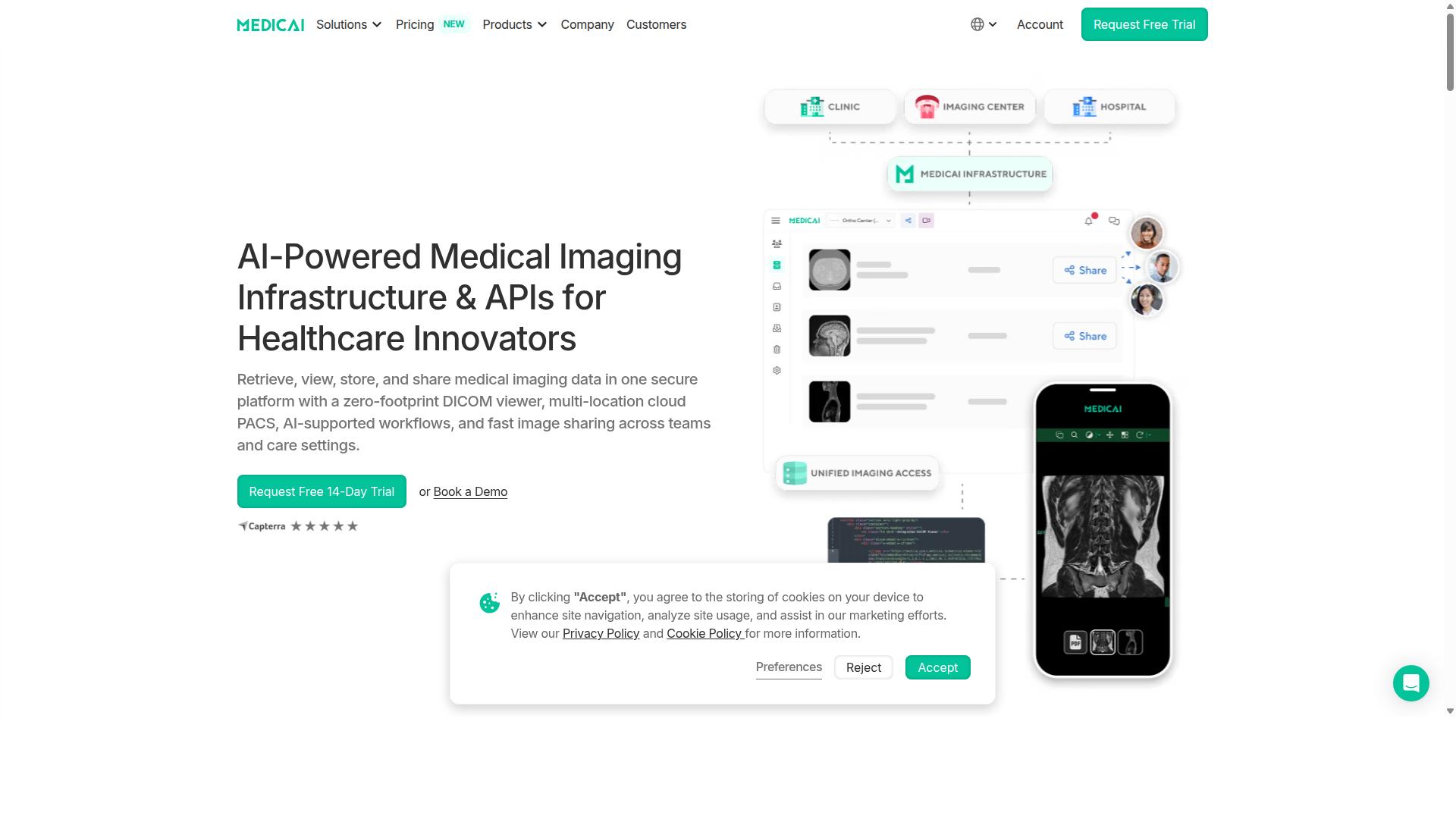
Medicai earns the top ranking by delivering a unified, zero-footprint platform that meets every integration criterion listed above.
Healthcare organizations select platforms that consolidate imaging workflows across multiple sites while maintaining security standards.
Enterprise imaging requires seamless connections between existing RIS and PACS systems without disrupting daily operations.
Medicai addresses these requirements through specific products that handle retrieval, storage, viewing, and sharing within one environment.
The platform eliminates the need for separate tools by combining Cloud PACS, Vendor Neutral Archive, and AI-supported workflows into a single solution.
Integration capabilities include DICOM Gateway for modality connections and structured reporting tools that feed data directly into EMR systems.
Partnerships with Microsoft Azure and Amazon AWS ensure infrastructure reliability while maintaining compliance with healthcare regulations.
Cloud PACS and Vendor Neutral Archive
Medicai's Cloud PACS and Vendor Neutral Archive replace on-premise silos with a single HIPAA/GDPR-compliant repository.
The 2 TB Standard tier storage provides baseline capacity for organizations beginning their cloud migration journey.
Automatic disaster-recovery snapshots protect imaging data against hardware failures or site disruptions.
IHE-compliant XDS-I profile support enables cross-enterprise document sharing between different healthcare facilities.
Migration timelines depend on data volume and network capacity, with retention-policy controls allowing organizations to set specific storage durations.
The Medical Imaging Uploader and DICOM Gateway facilitate secure transfer from existing systems to the cloud environment.
Backup and Disaster Recovery features ensure continuous access to patient studies across all connected locations.
AI-Supported Workflows and Structured Reporting
AI modules embedded in Medicai automate modality worklist creation and produce structured reports that flow directly into the EMR.
Partnerships with Rayscape.ai and MD.ai provide specialized AI tools for radiology workflows.
The Medicai Imaging API supports high-volume imaging environments.
DICOM tag morphing combined with HL7/FHIR feeds standardizes data formats across different modalities and systems.
Structured Reporting for Radiology transforms free-text findings into coded data elements that work together with existing EMR systems.
The Radiology AI Co-Pilot assists radiologists during interpretation while maintaining the final diagnostic responsibility with the physician.
AI-Powered Diagnostics capabilities extend to tumor board presentations and multi-specialty case reviews.
2. Intelerad

Intelerad offers an established diagnostic workstation suite with cloud-hosting options that some multi-site health systems already run. The platform focuses on enterprise imaging needs across hospital networks and large health organizations.
The system supports DICOM workloads and works with vendor neutral archives for unified imaging records. It handles radiology, cardiology, pathology, and point-of-care imaging through a single platform.
Intelerad enables secure image sharing across healthcare networks. The exchange capabilities help organizations access medical imaging data between different facilities and departments.
Deployment typically targets hospitals and large health systems. These organizations use the platform to unify their imaging records across multiple sites and specialties.
The solution integrates with existing RIS and PACS environments. It supports the interoperability requirements that multi-site health systems need for coordinated care delivery.
3. ProtonPACS
ProtonPACS supplies a fully managed PACS that smaller radiology groups can subscribe to without local hardware.
The platform provides storage tiers that scale with imaging volume. Organizations can adjust capacity as study counts increase without purchasing additional servers.
Uptime SLAs receive general coverage in vendor materials, and most enterprise imaging contracts include commitments around availability. Exact percentages vary by agreement.
Remote reading capabilities include multi-device access for radiologists working across locations. The system supports diagnostic review from workstations and tablets through standard web browsers.
Integration with RIS platforms occurs through standard protocols. The solution handles modality worklist management and study routing between connected systems.
Workflow orchestration features include automated worklist updates and real-time notifications. These tools help coordinate reading assignments across distributed teams.
Security measures center on HIPAA-compliant controls for data transmission and storage. Access restrictions and audit capabilities support compliance requirements in clinical environments.
4. EMSOW
EMSOW combines RIS scheduling with lightweight PACS functions aimed at outpatient imaging centers. The platform supports three distinct editions tailored to different practice types. Mobile Diagnostic Edition serves portable imaging companies while Doctor's Office Edition targets in-office imaging workflows.
Users can access built-in DICOM viewer capabilities along with scheduling and dispatch tools. The Teleradiology Edition supports remote reading services for distributed teams. Automated workflow features help reduce manual tasks across billing and reporting processes.
Core RIS functions include patient scheduling and modality worklist management. Structured reporting helps standardize documentation while automated claim generation assists with billing cycles. These components work together to support end-to-end radiology operations.
Medical billing integration allows for claim creation directly within the platform. The solution supports various practice sizes from small offices to larger mobile diagnostic services. HL7 connectivity enables basic EMR integration for patient data exchange.
Basic archive capabilities provide DICOM study storage and retrieval functions. The platform handles image lifecycle management through retention policies and data access controls. Multi-site imaging centers can use these features to maintain organized study collections.
How to Choose the Right Option
Decision criteria should map directly to the clinical workflows and IT constraints of the buying organization. Radiology, cardiology, and orthopedic departments each manage different modality counts and study volumes, which affects how an enterprise imaging platform integrates with existing RIS and PACS infrastructure.
EMR requirements also shape the choice. Systems that support HL7 and FHIR standards allow smoother data exchange between imaging platforms and electronic health records. Departments should evaluate how each option handles modality worklist updates and study routing across multiple sites.
| Department | Modality Count | Monthly Study Volume | EMR Integration Priority | Weight Score |
|---|---|---|---|---|
| Radiology | Enter count | Enter volume | HL7/FHIR | Calculate |
| Cardiology | Enter count | Enter volume | HL7/FHIR | Calculate |
| Orthopedics | Enter count | Enter volume | HL7/FHIR | Calculate |
Weight scores help departments rank platforms based on their specific needs rather than generic feature lists. A platform that supports DICOMweb and zero-footprint viewing may score higher for multi-site organizations with teleradiology workflows.
Target specialties should also consider retention policies and image lifecycle management. Orthopedic groups with high imaging volumes may prioritize platforms that support efficient data migration and cross-enterprise document sharing through IHE profiles like XDS-I.
Interoperability testing remains essential before final selection. Departments should verify that chosen platforms can exchange studies using standard protocols without disrupting existing modality integration or workflow orchestration processes.
Final Verdict
For organizations prioritizing rapid deployment, global accessibility, and measurable scale, Medicai provides the clearest path to consolidated enterprise imaging.
The platform processes 1M+ studies yearly and maintains 1.7M+ studies in storage. Over 300k+ visualizations of DICOM studies occurred last year, reflecting active clinical use across 70 clinics and hospitals.
HIPAA and GDPR compliance form the foundation of data handling. FDA and CEE cleared viewers add regulatory assurance for diagnostic workflows.
Integration occurs through 50M+ yearly API transactions. Microsoft Azure partnership supports secure infrastructure for multi-site deployments.
These metrics and clearances set Medicai apart from platforms lacking comparable transparency around volume and compliance status.
Organizations evaluating enterprise imaging solutions can contact Medicai directly to discuss specific RIS and PACS integration requirements.
Recommended Resources:

